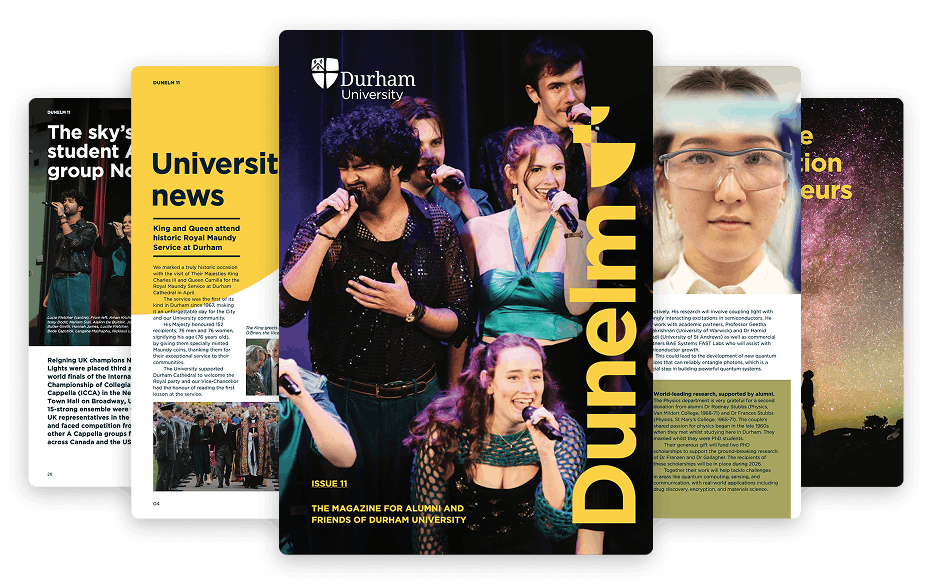
As a University community, we have much to celebrate from the past year and much to look forward to. We are grateful that you, our alumni and supporter community, continue to be our greatest ambassadors globally, advocating for Durham and supporting our students both throughout their studies and in their onward journeys.
We have been named in the QS World University Rankings World Top 100, a position we have achieved every year since 2010. This is a significant achievement. It speaks to the high quality and global standing of our University. Our position is hard won when many universities are competing for top rankings.
The World Top 100 ranking in this prestigious league table confirms the University’s strong global reputation for employability and reflects the quality and relevance of our education and research. Our research makes a difference to lives globally and locally. Our collaborative approach across our departments, faculties and research institutes increases its impact. We shared Durham’s exciting vision for transformative humanities with alumni at the annual meeting of Convocation recently. There is more detail about that, and our collaborative work across science, in this magazine.
Sustainability remains an important part of our University Strategy. Our staff, students and alumni endeavour to address the impact of the challenges of today and prepare for those of the future. The latest QS World University Rankings for Sustainability place Durham 22nd globally and eighth in the UK.
Our students and graduate entrepreneurs strive to find solutions to climate challenges and continue to develop social enterprise projects locally and internationally.
Richard Walker OBE outside St Aidan’s College
At Durham, our students receive a challenging, enabling and research-led education that encourages intellectual rigor. They are resourceful and able to apply their knowledge and skills to real-world challenges. We welcomed alumnus Richard Walker, CEO of Iceland Stores, back to Durham twenty years after graduating to share his experience with students. Richard describes himself as ‘environmentally conscious’ and credits his time at Durham, and particularly his degree in Geography, with shaping his passion to help meet the challenges of climate change.
St Mary’s College
We begin to consider our bicentenary in 2032 and reflect on our historic milestones. St Mary’s College opened as Durham’s first female-only college in 1899 and introduced male students 106 years later in 2005. The College is celebrating its 125th birthday this year. The generosity of the gifts left by some of St Mary’s remarkable alumni and friends support and inspire the journeys of the students of today. Two colleges formed against the backdrop of the educational reforms of the 1960s are celebrating 60 years: Van Mildert, one of our early co-educational colleges, and Ustinov, our only exclusively postgraduate college. Both are working closely with their alumni to secure their future goals.
Professor Kieran Fernandes, Professor Karen O’Brien and Mr Paul Polman
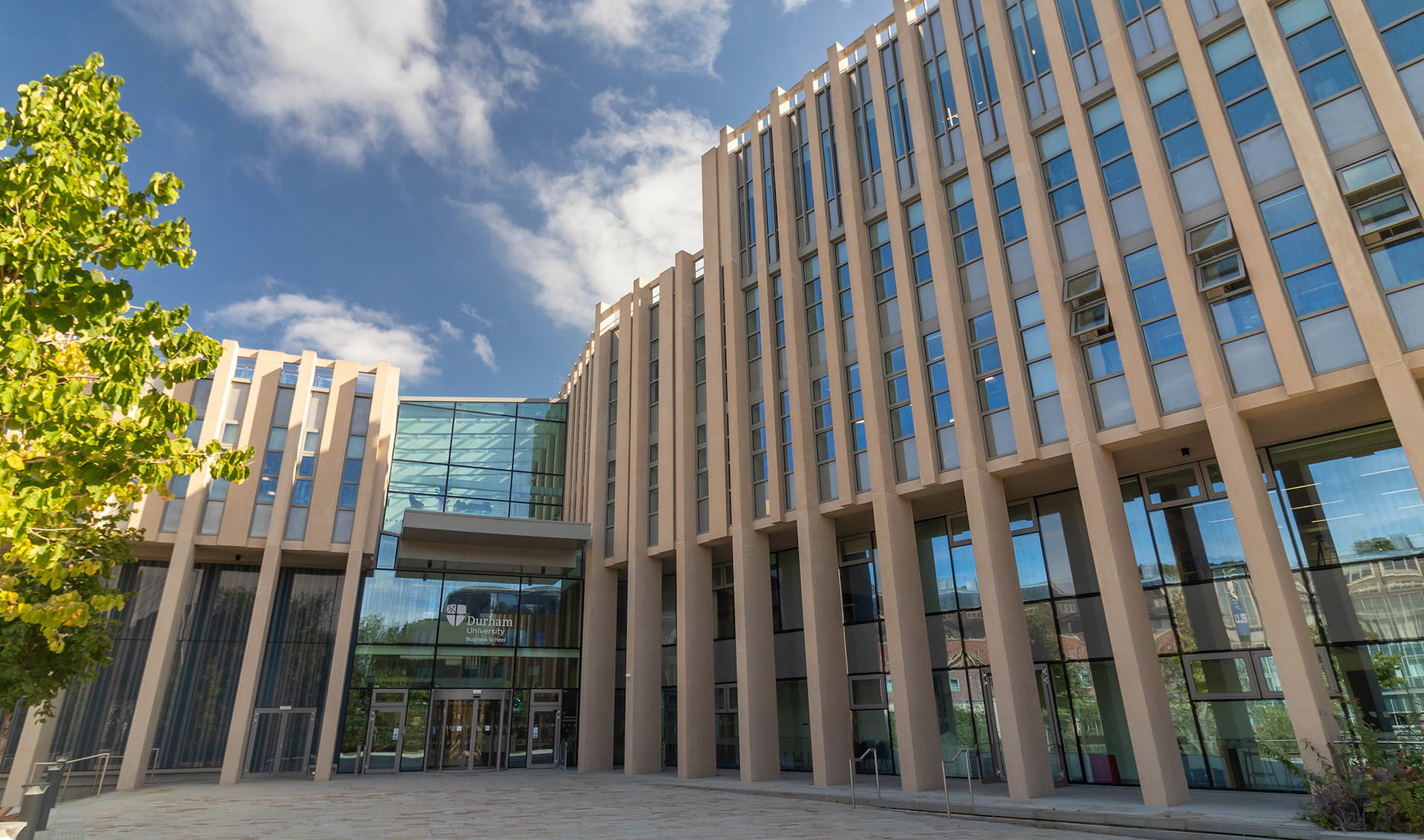
It has been a pivotal year for our world-leading Business School. Its new home, Waterside, was officially opened to find solutions to climate challenges and continue to develop social enterprise projects locally and internationally.
In the last year we have experienced challenging circumstances for UK higher education and we are grateful to the whole community for inspiring us with your achievements.
We have witnessed many alumni and friends being appointed to positions in Parliament and across all political parties following the UK general election. We were in awe of the sporting prowess of our Olympians last year and admired the determination of our young entrepreneurs to take on the challenge of the Dragon’s Den. Then at Christmas time, we cheered the triumph of our team in the alumni version of the University Challenge quiz show.
Thank you to those of our community who have contributed to this magazine. I hope you enjoy reading it.
Durham is building on its position as a global leader and innovator in science through a bold 10-year programme driving transdisciplinary, fundamental, and translational research. Anchored by our world-class expertise, we’re investing in exceptional talent, state-of-the-art facilities, and strategic partnerships to foster breakthrough discoveries and meaningful impact locally and worldwide.
Sustainability research through the Strategic Research Fund.
Our Strategic Research Fund (SRF) aims to stimulate significant growth in research income for the University through substantial investments in our research capability, community, and infrastructure. We have committed to invest around £18m over four years into six ground-breaking, transformative initiatives. With this investment, the projects will enhance our research capacity and work towards becoming financially sustainable. One of these projects is the SMART Soils project.
Supporting Sustainable Development Goals (SDGs) with SMART Soils
We have established a world first research group – the Soil and Microbiome Augmentation and Restoration Technologies Lab (SMART Soils Lab). The SMART Soils Lab will enable environmental engineers and plant scientists to design soil and plant restoration technologies which can optimise the services that soil can provide for us all. Insights from social science will promote a necessary shift in how society thinks about soil, moving towards an understanding that soil is living, and helping Government and industry sustainably manage land in urban and rural environments. SMART Soils Lab brings together expertise from our Engineering, Biosciences, and Sociology departments, along with an array of local and international government, industry and academic partners. The initiative will support the recruitment of new key staff across the three departments. Our long-term vision is that the SMART Soils Lab is recognised for its pioneering work developing a new field of nature-based environmental engineering of the soil microbiome to reverse fifty years of degradation and significantly contribute to the United Nations Sustainable Development Goals.
Just transitions to a net zero world
We will invest £5m over four years in JusTN0W through the Strategic Research Fund. The initiative aims to develop a world-leading interdisciplinary work programme to research sustainable and just solutions for accelerated decarbonisation of economies, and to achieve lasting societal well-being for present and future generations. JustNOW includes experts from Durham Law School, the Department of Computer Science, the Department of Economics and the Department of Biosciences. With this generous investment, JustNOW seeks to enhance our reputation and research by increasing our academic capacity and recruiting exceptional staff to join our institution, not only to generate significant growth in research income but also with a view to establishing robust pipelines of diverse talent. By collaborating across disciplines and harnessing our collective expertise, we are confident that JusTN0W will yield groundbreaking solutions to address the climate crisis.
The Worlds, Systems & Creations projection on the Ogden Centre for Fundamental Physics
Supporting the North East England’s growing space industry
Another SRF-funded project is the recently opened £5m Space Research Centre (SPARC), which draws upon our considerable and world-renowned expertise in space technology and research. Dr Andrew Aldrin, son of legendary astronaut Buzz Aldrin, gave the keynote speech ahead of the Centre’s opening. Andrew is Associate Professor and Chair of the Master of Sciences Space Systems, and the Master of Space Operations programmes at Embry-Riddle Aeronautical University, USA, as well as a leader in the field of space innovation and operations.
The Centre will be an internationally recognised hub of excellence in space research. It is founded on the principle of open, rigorous and independent research to grow the capacity and capabilities of space applications while protecting the space environment for present and future generations.
Our vision encompasses not only the pursuit of cutting-edge technologies but also the holistic understanding of space and its broader societal, ethical, and environmental impacts. Through responsible, multi-disciplinary research, including novel sensors, environment modelling, machine learning, governance and operations, we aim to address the complex challenges and opportunities of space exploration. By fostering collaborations and partnerships with national and international institutions, industry and organisations, we aspire to lead the way in shaping the future of space research and governance. Our core partners include the European Space Agency (ESA) and the Satellite Applications Catapult. Planning is underway for a range of joint research projects, training initiatives, access to facilities, and participation in space missions. The Centre includes researchers from our Department of Physics, Durham Law School, School of Government and International Affairs, Department of Computer Science and the Business School.
Physics and Astronomy alumna Dr Rosemary Coogan has taken another giant leap towards space by becoming the UK’s newest astronaut.
Rosemary, who holds two master’s degrees from Durham, was one of six astronauts to graduate after passing a year-long basic training programme with the European Space Agency (ESA). In becoming the UK’s latest astronaut, Rosemary joins a prestigious group that includes Helen Sharman, the first British person in space, and Tim Peake, the first British ESA astronaut.
Durham to host leading scientists including alumna Dr Becky Smethurst
Durham University will be hosting the Royal Astronomical Society’s prestigious National Astronomy Meeting 2025 this year. Up to 1,000 astrophysicists, mainly early career researchers from the UK, but also some from abroad, are expected to attend the event. The event will feature latest research, advances in the field and any topical issues and is being organised in conjunction with our Centre for Extragalactic Astronomy, the Centre for Advanced Instrumentation, the Institute for Computational Cosmology, the Institute for Particle Physics Phenomenology, and the Department of Mathematical Sciences.
Alumna Dr Becky Smethurst (Physics and Astronomy, St Aidan’s College, 2008-12) will be recording an episode of her podcast series ‘The Supermassive Podcast’ live from the event. The series on Apple Podcasts is recorded with fellow presenter Izzy Clarke, and explores topics related to space. These have included ‘What is gravity?’ and ‘Can we capture a primordial black hole?’
Research student in laboratory
Two of our scientists have been awarded prestigious fellowships.
Two researchers from our Department of Physics have been awarded Quantum Technology Career Acceleration Fellowships by UK Research and Innovation (UKRI) through the Engineering and Physical Sciences Research Council (EPSRC). These two fellowships, totalling more than £3m, are part of a £15 million investment to support early-career researchers working on cutting-edge quantum technologies.
Dr Tobias Franzen and Dr Liam Gallagher are among only 11 Fellows chosen across the UK for their potential to shape the future of quantum science. The fellowships will allow them to establish new research activities complementing existing research within Durham.
Dr Tobias Franzen’s research will be focusing on quantum networking using Ytterbium (Yb) qubits. He will work with industry partner VEXLUM (Finland) to simplify the complex laser systems required to work with Yb qubits and with Professor Matthias Keller (University of Sussex) to develop optical interfaces for Yb qubits. This work could help build scalable quantum networks and open the door to more secure and efficient communications.
Dr Liam Gallagher is exploring ways to make particles of light (known as photons) interact more effectively. His research will involve coupling light with strongly interacting excitations in semiconductors. He will work with academic partners, Professor Geetha Balakrishnan (University of Warwick) and Dr Hamid Ohadi (University of St Andrews) as well as commercial partners BAE Systems FAST Labs who will assist with semiconductor growth. This could lead to the development of new quantum devices that can reliably entangle photons, which is a crucial step in building powerful quantum systems.
World-leading research, supported by alumni.
World-leading research, supported by alumni. The Physics department is very grateful for a second donation from alumni Dr Rodney Stubbs (Physics, Van Mildert College, 1968-71) and Dr Frances Stubbs (Physics, St Mary’s College, 1965-71). The couple’s shared passion for physics began in the late 1960s when they met whilst studying here in Durham. They married whilst they were PhD students. Their generous gift will fund two PhD scholarships to support the ground-breaking research of Dr Franzen and Dr Gallagher. The recipients of these scholarships will be in place during 2026. Together their work will help tackle challenges in areas like quantum computing, sensing, and communication, with real-world applications including drug discovery, encryption, and materials science.
Dr Tobias FranzenDr Liam Gallagher
The programme is a commitment to a new approach to science at Durham, fostering a thriving environment that prioritises interdisciplinarity and impact to the benefit of the local region, industry strategic partners, and society at large. Research remains a focus for us, particularly on the themes of energy futures, quantum technologies, sustainability challenges in resource management and infrastructure development, Molecular and health sciences and data science, AI and robotics.
Since opening our doors to students attending our first taught programmes in 1965, our Business School has grown into one of the UK’s leading institutions, consistently recognised for academic rigour, a global outlook, and a commitment to responsible business. Over six decades, we have empowered generations of students to become influential leaders, entrepreneurs, and changemakers worldwide. The Business School has recently welcomed Professor Kieran Fernandes as Executive Dean, following the retirement of Professor Cathy Cassell. Kieran has been instrumental in securing and extending the Business School’s links to both local and international industry, creating the means for students to learn directly from industry, for CEOs and entrepreneurs to benefit from faculty expertise and to boost innovation and business creation to support wider society. Alongside his role as Executive Dean, Professor Fernandes also serves as Executive Director of the North East Local Enterprise Partnership (NELEP) Innovation Observatory, further strengthening ties with business and policy leaders.
The Waterside interior
Our 60th anniversary is a moment to celebrate the people and values that have shaped our School – academic excellence, global thinking, and a deep responsibility to society. As we reflect on our journey, we also look forward with confidence to an exciting future of innovation, collaboration, and impact.”
Professor Kieran Fernandes
A transformative step: The Waterside
In April 2025, Paul Polman – a global business leader, environmentalist and author – officially opened the Waterside building, our new Business School location. With exceptional facilities, Waterside positions the School as a dynamic hub for entrepreneurship, innovation, and knowledge exchange. It is also fittingly home to the School’s Executive Education provision, which includes short courses along with the MBA and DBA programmes. It has already proven to be an attractive conference venue, hosting the inaugural MBA Alumni Conference.
From left: Professor Kieran Fernandes, Sue Snowden (Lord-Lieutenant of County Durham), Professor Karen O’Brien, Liz Brown (Mayor of Durham), Paul Polman
At Van Mildert College, we are enjoying celebrating our 60th year in 2025 with current and past students, staff and supporters.
Van Mildert Freshers’ Reps (Freps)
Launching our year of celebration in London
The year of celebration was off to a flying start in January with a drinks and nibbles reception in London, hosted at Killik Stockbrokers in Mayfair. It was great to welcome many of our South East-based alumni, as well as some that had travelled from further afield.
Celebrating at the Norman Tower at Windsor Castle
The second major event in the calendar took place in the splendid setting of the Norman Tower at Windsor Castle, hosted by Lieutenant General Philip Jones, Governor of Windsor Castle and Van Mildert alumnus Mr Graham Barker. The evening provided an opportunity for alumni, friends and supporters of the College to strengthen and renew connections in a stunning and historic setting. During the evening, guests were invited to take a tour of St George’s Chapel and were entertained by world-class dulcimer player and alumnus Dan Evans.
A Gala Reunion Weekend in the Summer
In July, the traditional alumni reunion weekend in Durham is planned to be a glittering gala occasion. There will be a formal dinner in College, where alumnus and Olympian, Jonathan Edwards, will be speaking. There will be student bands, musicians and entertainers from throughout the last 60 fabulous years, as well as lots more activities. To mark the anniversary, there will be a photographic exhibition in College for the Gala Reunion to inspire memories from your time in College – and even the reconstruction of a student bedroom from 1965 – a real trip down Memory Lane for some!
We know that Mildertians have a special place in their hearts for the College. They hold cherished memories of their time here and have made connections for life. We look forward to welcoming them back, celebrating with them, sharing our plans and aspirations for the future, and most of all, having some fun.”
Professor Tom Mole, College Principal
The Van Mildert Feather
Wrapping up and marking the anniversary pre-Christmas
The year will wrap up with pre-Christmas drinks and nibbles in London, and a “Carols in the Bar” event at the Betjemen Arms at St Pancras, London.
60 years of history
Named after William Van Mildert, the last Prince Bishop of Durham, who was instrumental in founding the University in 1832, Van Mildert College opened its doors in 1965 to 350 male students. Following the expansion of university education in the 1950s and 1960s, and with Durham’s growth boosted even further by its separation from Newcastle University in 1963, four new colleges were added to the existing eight. Along with Van Mildert the other new Colleges were Grey, Trevelyan and Collingwood. In the early 1970s, Van Mildert was the first Durham college to admit female students; with the first formal intake in October 1972; the other colleges soon followed suit. Today, the College is home to almost 1,600 students, with over 500 living-in. The College motto is that of William Van Mildert – sic vos non vobis (“Not for yourselves”) – and in line with this ethos, the students are renowned for their outreach and volunteering activities, and strong community spirit: within and beyond our own walls.
Looking to the future
As we celebrate our first sixty years of transforming lives, we also look ahead to the second sixty. We’ve consulted with current students and alumni to identify four jubilee projects: exciting, ambitious and deliverable plans for improving the student experience. All four focus on creating the sense of belonging that makes Mildert so special.
The lawn at Van Mildert in 1967An Early Mildert Day
Our Jubilee Projects
Student Experience Funding to remove financial barriers and make sure all our students get the most out of their college life, regardless of their background, interests, and financial situation.
Common Room Space to give our students a place to gather, work, socialise and daydream over coffee. This space will bring livers-out back into college, improve students’ mental health, and be a hub for our ‘Critical Conversations’, which foster and model open, frank and respectful discussion.
A new Boat House to allow more people to try rowing for the first time and foster a renewed sense of community within the Boat Club. Rather than simply replacing the one destroyed in an arson attack in 2021, we want to create a better facility for both novice and competitive rowers.
Upgrades to the Ann Dobson Dining Hall to enrich the cultural life of College and upskill our student technical crews, allowing us to deliver more and better events like fashion shows, plays, concerts and formal dinners. We will renew the acoustic panels and install theatrical lighting and sound equipment.
We are extremely grateful to our alumni and supporters for their ongoing support.
To keep up to date with our plans as they unfold, visit the Van Mildert 60 page on our website, follow our socials or contact the College office on vm.development@durham.ac.uk
Our entrepreneurs – offering viable solutions to significant problems
From developing sustainable materials to exploring approaches to renewable energy, developing efficient software solutions or converting agricultural waste to fertiliser, the startups founded by our young entrepreneurs are leading the way to a better world. The unique combination of talent and passion for the cause and the gift of support and experience from our alumni community has resulted in some inspirational stories and plenty of optimism for the future. Two startups from the most recent cohort shared experiences of their entrepreneurial journeys to date and the role DVS played in their success. Meet Ground Up and Choppity – two of the startups from the most recent cohort from Durham Venture School (DVS). Over the next few pages, they share their journeys and explain the role DVS has played in their success.
Venture Lab – dedicated to inspiring young minds
Our Hazan Venture Lab was opened in September 2020 and has provided the University’s first purpose-built space for entrepreneurship. The facility was made possible with a generous donation from alumnus Jonathan Hazan (Computing, Hatfield College, 1988-91), who was keen to work with the University to create a dedicated space for student and graduate entrepreneurship. Jonathan’s support has been fundamental to the success of student entrepreneurship at the University, his advice and insights have been invaluable in nurturing student interest in entrepreneurship. The Venture Lab provides a dedicated space for young entrepreneurs to connect, collaborate and form a community. It is open to all our students and graduates working on new ventures or enterprising projects. Durham Venture School (DVS) is a two-year programme run by Venture Lab which is designed to encourage and equip our graduates for a career in entrepreneurship.
A programme like no other
The six-month DVS programme is accesible to all. Over a six-month period, the recruits develop the skills to tackle problems, find solutions and model those solutions into a business concept. There is the opportunity of a £10,000 investment per team and a mentor from our alumni community to help them refine their plans.
Thanks to a further donation from Jonathan Hazan to fund two further cohorts of Durham Venture School. The opportunity will shortly be offered to graduates for academic years 2025/26 and 2026/27.
Aaron and Zara presenting Choppity on BBC2 show Dragon’s Den
Choppity: taming the Dragons
Computer Science graduates Aaron Morris (Stephenson College, 2019-22) and Zara Paul (South College, 2021-24) created Choppity, an innovative web-based AI video editing platform designed to simplify the video-editing process for podcasters and businesses. The platform is already used in production by leading companies such as ITN, Autotrader, Turtle Bay, and Sonatype. Founders Aaron and Zara appeared in the latest BBC2 series of Dragons’ Den in a bid to secure investment. They explain how the DVS experience impacted their vision.
What was the inspiration for your project?
(Zara) We met in my first year at Durham and we started building things together pretty much since we met. At first it was just websites, a game, then a photo book editor, then a graphic design app. The app failed as a business after a year and a half for several reasons. Firstly, we had absolutely no way of making any money from it, but also, we became very aware that social media was favouring video more and more. It was becoming a bigger and bigger medium but didn’t have tools that made it accessible for people who want professional-looking video. So, we decided to do something in the video space. (Aaron) I had learned about the different ways to promote a company, and it struck me that a small business couldn’t possibly spend the time creating all those different types of content and still produce the best product, so my idea was to create a system that could take a single blog post and repurpose that content into several other types of content. This turned into taking long-form video and turning it into short-form content.
How did DVS help you develop your plan?
(Zara) When Aaron joined the DVS cohort in September 2022, we decided to start our project again using proper startup principles. We spent time interviewing potential customers, asking them about their problems and actually just really following the course. It was here that we almost started again using the learnings that we had gained. (Aaron) Because it’s one thing to just have an idea, but ideas are kind of useless. It’s the execution and there’s a lot of best practice on how you actually take an idea or a product into turn it into a company with actual customers.
How useful was the support and advice of your alumni mentor?
(Zara) He was great. He has an impressive track record in B2B software sales, and has experience in scaling several major companies, so he was able to challenge our thinking. There was so much groundwork that we needed to lay with him before we could get to the questions that we wanted to get to, and he really helped us think critically about why we were doing what we were doing, and what we actually wanted to achieve. We met weekly or bi-weekly, and he made a massive difference in the early stages. We even met him with Marek and his colleague, Chris, to help us prepare for Dragons’ Den. We worked through so many practice pitches with them that we were a little disappointed when the Dragons didn’t ask us some of the really difficult questions!
Would you have any advice for students considering applying for a place on the programme?
(Zara) I think that anyone who isn’t someone who enjoys conventionality should do it. It was a great safe space to explore an alternative career path. I recently went to the alumni event where some people were saying that DVS is still at the very top of their CVs when applying for jobs, and it’s still the bit that potential employers find the most interesting because it’s where they learn to become the most resourceful. I think it takes a certain kind of person to start a company, and it takes a certain kind of person to go through the programme.
Where are you now and where do you see Choppity in five years’ time?
(Aaron) We very much measure our business against revenue, but also the retention of our customers, which is what ultimately will give the business longevity. We’ve always viewed each startup as a step to the next. The first one was a flop and a useful lesson. Then came Choppity. We have learned how to handle customer support development operations, and then we think the next one is going to be on a larger scale, using sibling technologies, perhaps a venture capital (VC) funded startup. So, I would like to see Choppity in the hands of someone who can really take care of it. It could be a business tool that’s used more widely and for more applications. We may well still be involved in some way. I’m sure we will create the next startup in the near future – five years is a very long time…
Ground Up: a success story in the making
Founders: Naveen Shivalingam (Mathematics, Collingwood College, 2019-22) and Rhea Dabriwala (Philosophy, Politics and Economics, Collingwood College, 2019-22) Based in Mumbai, Ground Up is aiming to create India’s most scalable biochar production model. The process is an environmentally friendly method of disposing of agricultural waste by turning it into biochar, which can then be fed back into the land, reducing carbon in the atmosphere and nourishing farmland to help increase crop yield. They generate carbon credit tokens to sell to large companies abroad to offset emissions. Founders Naveen and Rhea explain how the Venture School experience impacted their vision.
Carbon markets are trading systems in which carbon credits are sold and bought. Companies or individuals can use carbon markets to compensate for their greenhouse gas emissions by purchasing carbon credits from entities that remove or reduce greenhouse gas emissions. One tradable carbon credit equals one tonne of carbon dioxide or the equivalent amount of a different greenhouse gas reduced, sequestered or avoided. (United Nations Development Programme)
Where did the concept for the project come from?
(Naveen) That’s a very good question! We always knew we wanted something a little bit more out-of-the-box, and in our third year, we became interested in carbon markets* and the concept of what this could achieve. We researched the dynamics of this market and the perceptions of the various stakeholders, but to us it seemed a little messy – a little broken. The ideas just kind of came to us continuously. We just kept refining them and kept changing them – there were a lot of bad ideas along with the good ones, but we knew, and Marek and Chris at DVS reassured us, that we were on the right track. I still don’t even think we found the answer of what our business is yet. It’s constantly evolving and I think that was one of the things that they taught us at DVS. So, long story short, I’ll let you know the answer when we get there!
How did DVS help you develop the plan for Ground Up?
(Naveen) When we took that step into DVS, our thoughts gained more direction. Both our solutions and our energy became far more targeted. Our first meeting with Marek at DVS lasted about two hours! He had endless patience and recognised that we were passionate about the challenge that we had identified, and that DVS could give us the tools to develop a commercially viable solution. Deciding become an entrepreneur can be very lonely in the sense that you don’t have a lot of people that understand that journey. One of the greatest aspects of DVS was to connect with other would-be entrepreneurs. We relied on the network for advice or to understand what that journey would look like, or just to discuss kind of what we were thinking about and what we were doing.
How useful was the support and advice of your alumni mentor?
(Rhea) Incredibly useful. Our mentor was Luke Young who founded Alora. He was knowledgeable, supportive and like-minded, as he also worked in climate action and climate impact. Even more importantly than the practical help and support, he encouraged our mindset. He gave us the confidence that dreaming big is never a bad thing.
Where are you now? And where do you see the company in five years’ time?
(Rhea) We have raised external capital, and we are planning to open the first full-scale industrial plant of its kind in this region by June. We are starting to see traction with collaborative partners and customers – and our team is growing. When we first moved here a year and a half ago, we were based in a garage with three staff. We now employ seven and we are a fully-fledged company with an upcoming industrial facility and an international presence. Our goal is that in five years’ time we will have set up at least 30 industrial facilities – 30 by 2030. That means we will be converting hundreds of thousands of tonnes of residue and diverting it towards producing fertiliser and moving carbon dioxide out of the atmosphere. We will be making a real impact both on the climate and on the agricultural sector in India. (Naveen) There are hundreds of districts in India, each with their own cultural and linguistic backgrounds. We plan to be in as many of those districts as possible, creating hubs of employment with sustainable fertiliser and farming practices. Our brand and what we stand for would be ingrained in the Indian agricultural system.
Would you have any advice for students considering applying for a place on the programme?
(Rhea) I think it would be to just do it! It is just the best experience – my favourite memory from my time at Durham is the time that I spent at DVS. It has really shaped me personally and professionally. It is genuinely a wonderful programme that not a lot of other universities offer, we are still blessed to have access to such amazing resources. I would say that if you even have an inkling of an idea or a feeling that you want to do something out there in the world on your own to really make a change, DVS is the best place to start.
Naveen and Rhea on site in Mumbai
If you are interested in supporting the programme as a Durham Venture School alumni mentor, please contact Chris Gilman by emailing chris.gilman@durham.ac.uk
I now realise that geography is the absolute kernel of inspiration; it’s helped me to see the bigger picture, to look at things in the context of the wider world and also to see the micro details. Different aspects of geography influence everything I do, every day.”
Richard Walker
Alumnus Richard Walker OBE (Geography, St Aidan’s, 1998-2001) and Executive Chairman of Iceland Foods and Bywater Properties visited Durham recently to deliver a lecture to our students. He describes himself as being ‘environmentally conscious’ and explained how his studies and university experiences have helped shape his career and his life. The lecture was attended by current Geography students and introduced by Head of Geography, Professor Colm O’Cofaigh. Richard fondly recalled his days at Durham, telling the students that Durham was ‘the making of him’. He credited this partly to the collegiate system, which meant there were countless ways to get involved in many activities. He also spoke highly of his degree, reflecting that everything he has done in his career comes back to Geography.
Students heard how Richard considers Geography to be even more relevant now than it was when he graduated in 2001, adding that he is delighted to see Durham forging a reputation as a world leader in climate adaptation and hazard, risk and resilience studies. Over the past decade, climate change has earned a place on everyone’s agenda, with every major organisation having an Environmental, Social and Governance department. This approach requires specialist management expertise, which can only augur well for the employment prospects of graduates with a Geography degree from Durham. Richard feels confident that this transparency and accountability become more important, with sustainability becoming an increasing focus for business.
Richard and his father
Richard’s family business is the British supermarket chain, Iceland, but he didn’t plan on going into the business. After graduation, Richard continued his studies to qualify as a chartered surveyor, eventually setting up Bywater Properties, of which he remains Chairman. His environmental conscience is also evident here: in 2023, Bywater signed a £1b joint venture agreement with a Japanese Forestry Corporation to promote mass timber development and construction of commercial property throughout Europe.
In 2011, Richard finally joined the business founded by his parents in 1970, frozen food retailer Iceland. The decision was driven partly by his desire to be near his family but also by his concern over the environment. He took great pride in the Iceland strapline his father had created years before: ‘Doing it right.’ They had already led the way for British retailers by banning artificial additives and colourings. “My dad led the charge against genetically modified foods in the UK, he coined the phrase ‘Frankenstein foods’.”
The frozen food retailer already had a track record of making a real difference through disruptive change, so he set out to ‘do it right’ in his own way – by taking the challenges of climate change right to the heart of the communities served by many of the 1,000 Iceland stores. He advocates that wanting to create a better and more sustainable world should not be the responsibility of those with the privilege of wealth, and as Iceland stores are located in some of the most deprived communities in the UK, his customers could make a difference too. “It’s easy to assume that someone struggling to feed their family on as little as £25 a week, can’t afford to care about plastic in the ocean – or the loss of the orangutan. That’s a lazy assumption – and it’s wrong.”
As a keen advocate of social and environmental change, Richard saw an opportunity to make a real difference, to support the five million customers shopping in Iceland stores each week, and to use the powerful platform to introduce sustainability programmes such as banning plastic and palm oil from Iceland’s own brand products. Iceland has also signed the climate pledge to reach net zero by 2040.
Richard is passionate about improving the lives of his customers and giving them cost-effective options while recognising the importance of sustainability. Sometimes, this can be a challenge, but his belief is that consumers and retailers must work together to address this growing issue. “It’s my core belief that we’ll never meet the challenges posed by climate change if they remain the concern of the comfortably-off middle classes. We need to democratise environmentalism.”
Ultimately, Iceland is about helping people, Richard shared with the students. They offer 10% off for the over 60s on Tuesdays and run the Iceland Food Club, which provides micro-loans to families during the school holidays. Iceland is also the largest recruiter of ex-offenders in the UK and its charitable foundation has given out more than £37m in grants.
Richard and colleagues from Iceland Foods
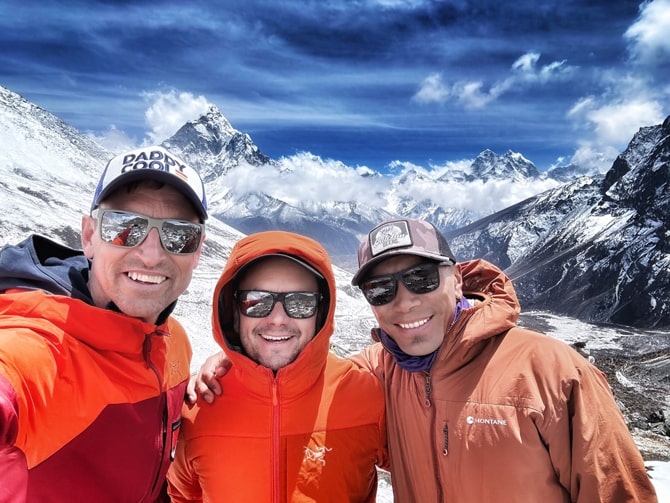
It was a pretty special feeling: a month’s expedition, six months in training, but really ten years in the making, since I was last there with Dad.”
Richard Walker
Richard at the summit of Everest
Following his mother’s dementia diagnosis, Richard’s father planned an expedition in 2011 to climb Mount Everest with the target of raising £1m for dementia research and to help build the world’s first rare dementia support centre. Richard joined his father on the three-month trip, but unfortunately, ill heath meant that the pair didn’t quite make it to the summit. Some members of the expedition did, however, and the £1m target was reached.
In 2023, following the loss of his mother in 2021, Richard pledged to return to Everest and complete the challenge. This time his trip was to last just one month, and he was accompanied by two experienced climbers. The climb was challenging and fraught with danger, the level of difficulty increasing with each of the four camps en route to the top. Camp Four is known as the Death Camp, where 18 climbers had perished during 2023, including a Canadian climber that had befriended Richard at Base Camp.
After triumphing over sickness, sunburn and retinal haemorrhage, the trio finally made it to the summit and raised another £1m for The National Brain Appeal to fund the building of a dementia research centre. Building starts this year. Richard admitted to the students that there were many times on Everest that he had wanted to give up and go home, but he acknowledged that quitting was the easy way out. He shared five personal learnings from the experience that apply equally to business, family, life – but also to studying and careers:
Clear your mind and focus on the task in hand.
Be persistent – just put one foot in front of the other.
Be resilient and keep going – you will achieve your goals.
Value what you already have.
Live for each day and be passionate about what you do – life is very short.
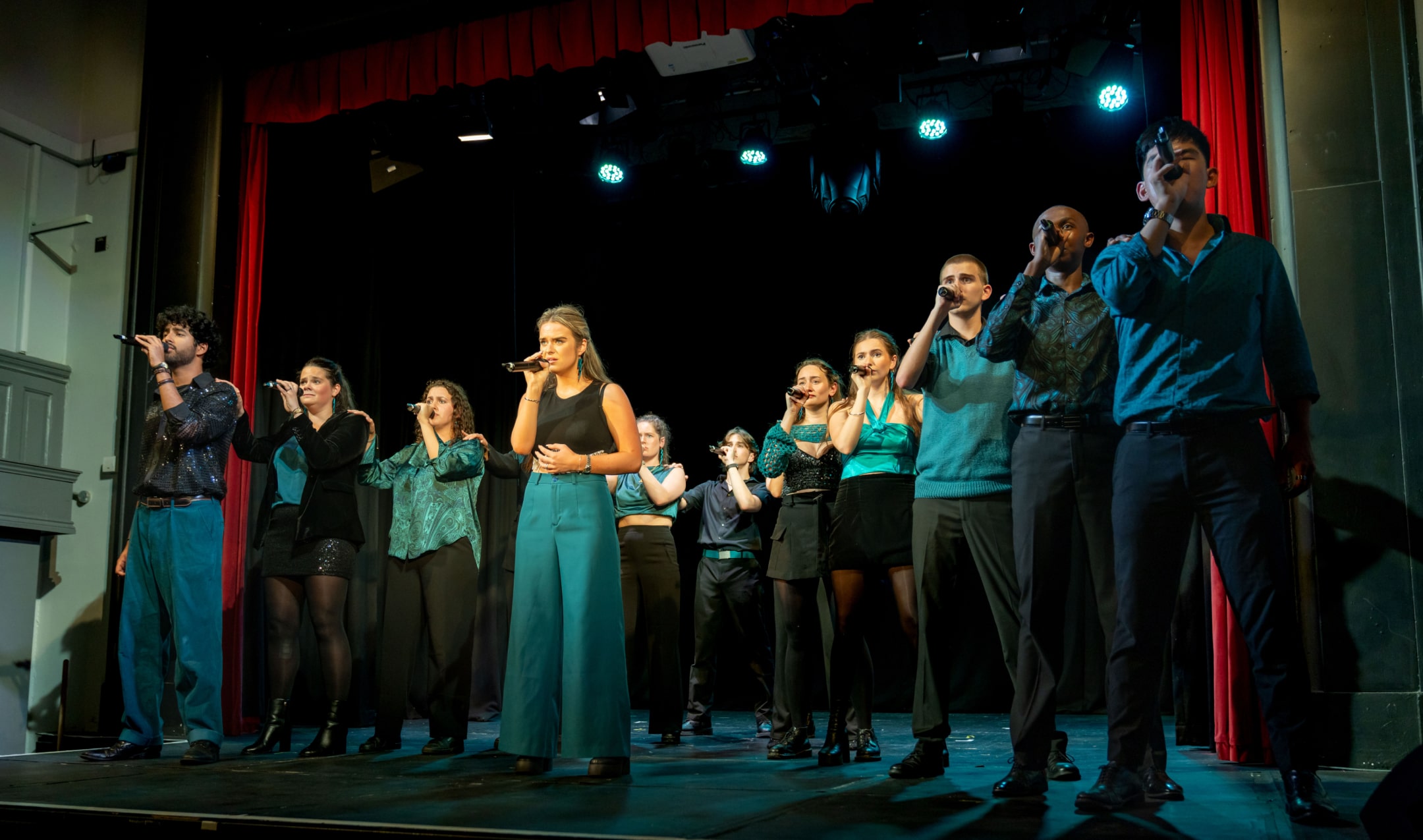
Lucie Fletcher (centre). From left: Aman Krishna, Issey Dodd, Mariam Siali, Aislinn De Buitleir, Joe Butler-Smith, Hannah James, Lucille Fletcher, Bede Capstick, Lengana Mashaphu, Nicklaus Lau
Reigning UK champions Northern Lights were placed third at the world finals of the International Championship of Collegiate A Cappella (ICCA) in the New York Town Hall on Broadway, USA. The 15-strong ensemble were the only UK representatives in the finals and faced competition from nine other A Cappella groups from across Canada and the USA.
Their set, which was arranged entirely in-house by the group’s Musical Director, Aman Krishna, included performances of ‘Somewhere Over the Rainbow’ from ‘The Wizard of Oz’, ‘Dream On’ by Aerosmith, ‘Golden Slumbers’ by the Beatles, and ‘Night Fever’ by the Bee Gees. This placed them in third position on the leaderboard, marking the first time a mixed UK A Cappella group has ever placed on the podium at these internationally recognised awards. This year isn’t the first time Northern Lights has reached the finals of the ICCA. They first qualified in 2023, in their 10th year as a group. They repeated this in 2024, wowing audiences with their vibrant set, where Lucie Fletcher also came away with a coveted ‘Outstanding Soloist’ award. In 2025, Northern Lights retained their UK ICCA championship title for the third consecutive year (fifth time overall), progressed to the international ICCA finals for the third time. Outside of ICCA, at the start of the year, the group won the UK’s Open A Cappella Competition in Warwick against nine finalists (including non-collegiate groups). They also won two special awards for Exceptional Arrangement and Exceptional Choreography. Northern Lights’ talent and sheer determination has taken them on a demonstrable upwards trajectory year on year. In the past two years, the University has supported their development through a dedicated resource from Performing Arts for Jazz and Commercial music.
A huge thank you to all of [our alumni]. Northern Lights would not have got to this place had it not been for all of our fantastic alumni, and we are beyond grateful. Thank you so much for all of your support always, and we hope we have done you all proud!”
Joe Butler Smith
Northern Lights President
The group is in its 12th year as a student-led, mixed vocal ensemble. Fourteen singers and a beatboxer perform a wide range of genres from mainstream pop to musical theatre ballads. Their singing takes them around the world, from headlining sell-out shows at Durham’s Gala Theatre, to the world-famous Edinburgh Fringe, and New York. The group arrange all their own music in close collaboration with previous alumni generations, many of whom provide regular mentorship and support their performances in the UK and the USA. The ICCA is the competition that the ‘Pitch Perfect’ movies are based around. It was founded in a college dorm room in 1996 and has since grown to include 450 groups competing in nine regions in the US and Europe.
Northern Lights’ success on national and international stages is an extraordinary achievement. To see them not only repeat, but build on these each year amidst the change brought by the academic cycles, is incredible and testament to their hard work, drive and determination. Each member balances their busy extra-curricular schedule with academic and potentially also College commitments, making their success in New York even more laudable.”
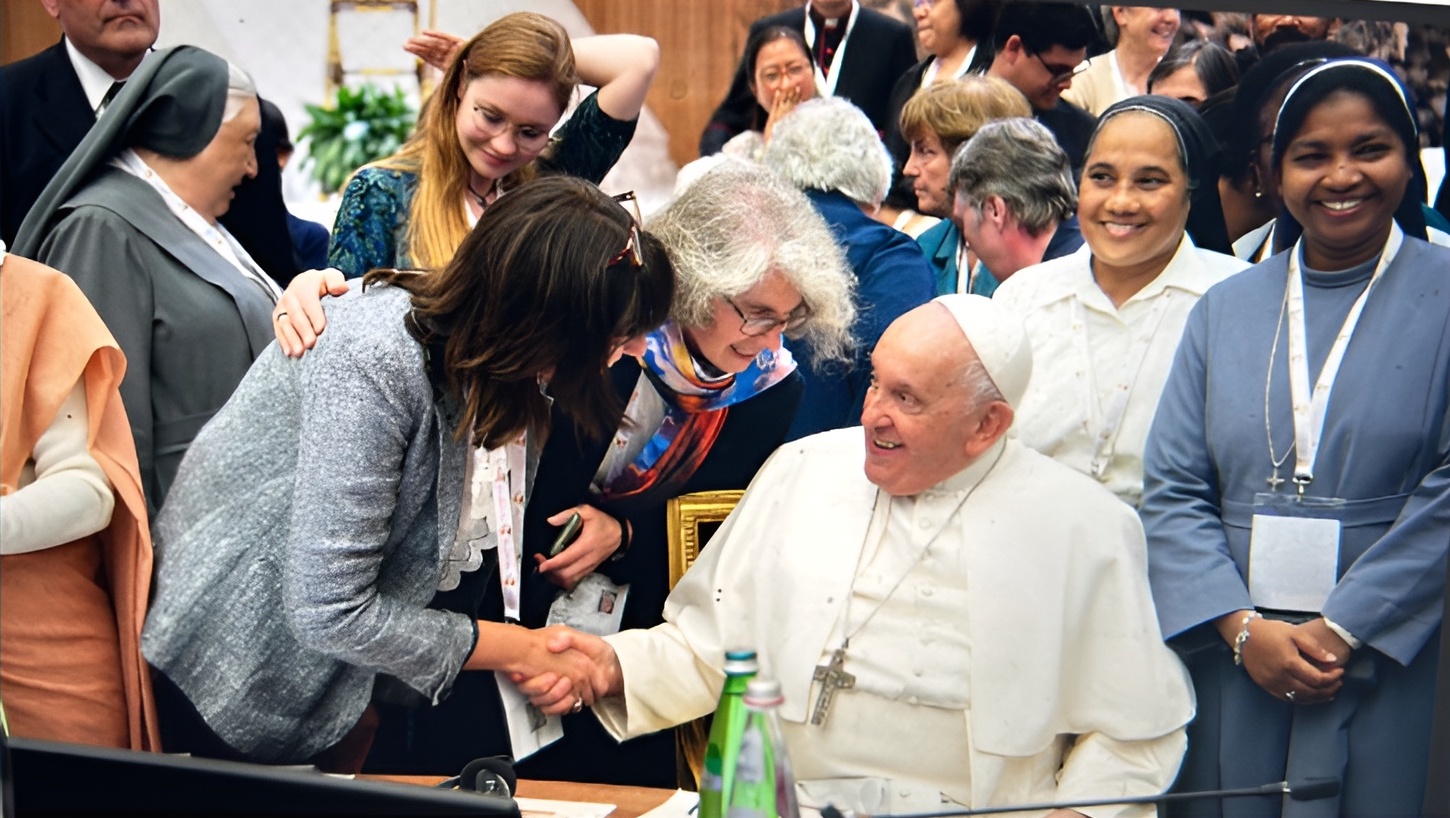
Professor Anna Rowland, shaking hands with the late Pope Francis
Academics at Durham are using their expertise in humanities to transform the world around them. At our recent meeting of Convocation, Professor Janet Stewart led a panel discussion between some of our eminent academics, who shared examples of the positive impact their work can have in informing real world challenges.
Professor Edith Hall – transforming opportunities with Classics
Professor Edith Hall from our Department of Classics and Ancient History is passionate about the lessons we can learn from ancient civilisations and is leading a campaign to put Classics education back on the UK curriculum. Edith seeks to align her study of ancient civilisations to modern-day issues, and her research has taken several directions by exploring issues such as gender, ethnicity, and social class through the lens of ancient literature. Edith’s latest project is a collaboration with the prison service and a prison education charity Novus. She is teaching ancient Greek philosophy and ethics to explore how we should act as individuals and societies in prisons. Starting with County Durham, she has designed a course for Novus to trial in a prison and it is now planned to be used more widely in other prisons. Her premise is based on the Aristotelian principle that if you try to be a good person, you will be happier. Her research, her publications and public engagement put urgent contemporary issues at the centre of the radar, using ancient Greek and Roman culture to sharpen modern thinking on ethnicity, gender, social class, mental health and the environment.
The panel at Congregation (Professor Karen O’Brien with L-R Professors Janet Stewart, Edith Hall, Alex Broadbent, Anna Rowlands, the late Simon James)
This was the most inspiring teaching I have ever done in my life. There is a palpable, quantitative difference in self-confidence and poise. None had ever asked these men if they thought that being good would make them happier.”
Professor Edith Hall
Transformative Humanities brings together distinctive approaches to humanities research and education within the academy and across a wide range of partners and communities. It is an approach designed to enrich, shape and change lives. Transformative Humanities links together all research and related activities, and research-led learning. It engages with all of our learning and research communities, from undergraduates to professional services, postgraduates to academics and provides a thinking space for sustainable research. Transformative Humanities draws across chronologies, from ancient and medieval worlds to contemporary questions and future directions.
Inflected across and between disciplines, it focuses on six thematic areas:
This framework celebrates the value of the arts and humanities and the insights and impact of our work, through many avenues of outreach, engagement, knowledge exchange, and widening participation, involving all our learning and research communities.”
Professor Janet Stewart
Executive Dean, Faculty of Arts and Humanities
Professor Anna Rowlands – transforming political challenges with Theology
Professor Rowlands is a leading political theologian who works at the interface of political and social theory and Christian Theology. Since March 2023, she has been helping to shape the future of the Catholic Church on a prestigious two-year secondment to the Vatican. We recently heard the sad news of the passing of Pope Francis. During his papacy, Professor Anna Rowlands was among researchers from our Department of Theology and Religion who followed his work closely and participated in his initiatives to help shape the future of the Catholic Church. Anna has been actively working with the team managing the global Synod process established by the late Pope. The Synod is the largest grassroots listening process ever undertaken by the Catholic Church and aims to renew processes of participation, governance and mission in the life of the Church. Anna believes that there are real benefits of a collaborative interdisciplinary approach, not only in adding a different dimension to an existing challenge, but also to the scholar. She believes that broadening perspective increases depth of insight and improves the quality of the questions asked.
Talking Humanities
The Talking Humanities series of podcasts features insights into collaborative projects working across the University and beyond – changing the ways in which we think and work. The first episode features Professor Giles Glasper, professor in High Medieval History specialising in the intellectual history of the high middle ages and particularly in the development of theology and Deputy Executive Dean of Research, Faculty of Arts and Humanities. Joining him in the episode is Professor Brian Tanner, an Emeritus professor in the Department of Physics. They are both members of the interdisciplinary Ordered Universe project which studies the scientific works of the 13th century polymath, Robert Grosseteste. They talk about how they met through the Ordered Universe and how their work in humanities and the sciences became intertwined. They discuss the unexpected discoveries and co-authored publications which came from the project, engaging with artists and young people as well as offering advice on setting up large-scale research projects. The series highlights the transformative strength of Arts and Humanities and hopes to inspire further reflection and activity. In each of the seven episodes, a leading academic from the Faculty discusses an area of particular interest, often collaborating with an expert from another of our Faculties. The discussions illustrate how an interdisciplinary approach can add extra context and dimension to any of the projects.
My collaboration with the Vatican has been to support a global listening process to understand the aspirations of grassroots Catholics around power, participation and belonging in a truly global Catholic community. My job has been to think about how we could interpret the data we were getting from the grassroots and present it to the world theologically.”
Professor Anna Rowlands
This perspective on the Humanities amplifies Durham University’s long-standing research excellence in this area and brings the insights of humanities to bear on disciplines in Science, Business, and Social Science. It also addresses the needs of our communities and the challenges of the higher education sector.”
Being the Principal of St. Mary’s College is always a privilege. Being fortunate enough to lead our amazing community when we are celebrating our 125th Anniversary is an unforgettable honour.
Mary’s foundation was as a pioneering college. Opening as the Women’s Hostel in 1899, it provided the first opportunity for women to study for a degree on the same residential basis as men. Mary’s is committed to being as pioneering in future as it has been in the past.
To this end, and to complement existing support, thanks to the generosity of our alumni and friends, we are launching a range of additional scholarships and bursaries to celebrate our 125th Anniversary. We want Mary’s to be at the forefront of widening access to higher education within Durham. As well as celebrating our Anniversary, we plan to extend those scholarships and bursaries particularly at the postgraduate level and to ensure our student focussed spaces are of the highest standard, so that we can ensure that coming to Mary’s and taking a full part in our community is never restricted by background.
By doing this, we can build on the 125 years of students who have taken Mary’s values with them out into the wider world.”
Professor Adrian Simpson
Principal of St Mary’s College
Our history
When six female students were granted scholarships in 1897, there were no University buildings dedicated to house them. In 1899, The Women’s Hostel was established in rented accommodation at 33, Claypath and Miss Laura Maria Roberts was appointed as Principal.
In 1900, Elizabeth Robinson, who had taught at Durham High School for Girls, was appointed to replace Miss Roberts and in early 1901, the students moved to Abbey House.
In 1919, the Hostel was accepted as a College of the University, being renamed St Mary’s, and the increasing number of female students were rehomed to No.8, the College, where they remained until moving to the current location.
In 1947, Princess Elizabeth laid the foundation stone for the new college building, and works were completed in 1952.
St Mary’s permanent home was designed by architect Vincent Harris, with considerable input from the then Principal, Margaret Fergusson, to temper the architect’s ideas with the practicalities of the needs of a women’s college. The main building, which came to be called the Fergusson Building, was joined by the Williamson Building in 1962 and by a new hall (the Kenworthy Hall) and atrium in 1993 to become the set of buildings which forms St Mary’s College today.
Miss Fergusson was Principal until 1955, followed by Dr Marjorie Williamson, Mary Holdsworth, Irene Calvert and then Joan Kenworthy from 1977 until 1999, taking the College through to its centenary year.
The growth of student numbers in that second half century brought with it more opportunities to engage in wider student activities, most organised through the Junior Common Room (JCR). In 1979 the JCR took the decision to rename the role of ‘Senior Woman’ to ‘President’ of the JCR and, in 1996, in recognition to the amount which the role has grown to encompass, it became a paid sabbatical role for a student to take on for a year after they had completed their degree.
Over a century after its foundation, St Mary’s admitted men for the first time in 2005. 92 male undergraduates were admitted, making up over 40 per cent of the intake in that year. The then Principal, Jenny Hobbs, said: “We are preparing to become a distinctive college for women and men. We are proud of the diversity of our students and strive to inspire all who enter with a belief in achieving their own potential, not only in the world of academia but in many walks of life.”
Celebrating enduring spirit
St Mary’s’ 125th anniversary year is a celebration of our rich history and the remarkable journey of St Mary’s College. From the pioneering women of that first academic year of 1899-1900, to the inspiring and diverse community of today, the indomitable spirit of St Mary’s remains constant.
It is fitting that in the year of St Mary’s Anniversary, the College is remembering two of its community who continue to impact the lives of students of the present and future. It is with fondness, gratitude and sadness that the College remembers alumna Margaret Bloomfield and former Principal, Joan Kenworthy, who both died recently.
These inspirational women have acknowledged their time at Durham through gifts in their will. Their legacies will prove transformational for Mary’s students and for the College.
The day I received a scholarship from St Mary’s College, among excitement, relief and joy, the one feeling that dominated was gratitude. Many students like me come from difficult financial backgrounds and coming to university can be so daunting with so much to partake in and enjoy. I am extremely grateful to St Mary’s for giving me this significant opportunity that will allow me to freely take part in college life.”
Hetty Lort-Phillips
recipient of a St Mary’s scholarship
Margaret Bloomfield
(English Literature, St Mary’s College, 1944-47)
Margaret remembered Durham, and specifically St Mary’s College, in her will with the words “In gratitude for my four happy years at St Mary’s which made possible my rewarding career”.
Following what is believed to be the largest single donation to the College, a series of scholarships and bursaries in Margaret Bloomfield’s name were formally announced by Principal Professor Adrian Simpson at a dinner to celebrate the 125th anniversary. He said: “Miss Bloomfield’s ongoing support for the College is typical of the sense of belonging which successive generations of our community have fostered. We are full of admiration for her lifelong commitment to education and grateful for the support of all of our generous benefactors.”
While the College has a number of existing generous donations supporting students from lower income households, these are the first permanently endowed, fully-financed scholarships in St Mary’s College’s 125-year history.
The scholarships will be awarded to students from lower income households, and it is planned that at any one time, there will be up to five Margaret Bloomfield scholars at varying stages of their undergraduate studies.
Margaret’s legacy will also fund a number of bursaries to ensure as many students as possible can benefit from the collegiate experience, regardless of financial circumstances.
After reading English Literature at Durham, Margaret undertook a further year’s study to obtain her teaching qualification. After completing her studies, she had a long and fulfilling career in education, at the time becoming one of very few female secondary school Head Teachers.
Margaret had met her two closest friends even before arriving at St Mary’s; they met on the platform at Doncaster railway station whilst waiting for the train to Durham. The three were lifelong friends and Margaret remained in close contact with the family of Margaret’s good friend Lucy Fields.
Margaret was an important part of my life and often told me ‘my time at Mary’s made me the person I am and led to all I achieved’. She simply couldn’t speak too highly of Mary’s, and she and my mother always remembered their student days with great fondness.”
Rachel Linfield
Daughter of Lucy Fields
Joan Kenworthy by artist in residence Jane Kitching
Joan Kenworthy (College Principal, 1977-99)
Joan was one of the longest serving Principals of St Mary’s College, having led the College between 1977 and 1999. In those 22 years she was the driving force in its development. This included overseeing a considerable expansion, adding the conference hall behind the dining room and an additional wing on what is now the Williamson Building. She was instrumental in building the warm relationship with Teikyo University which remains strong to this day. She also generously endowed a prize in the College for student leadership.
Her significant contribution as Principal of St Mary’s is recognised by the naming of Kenworthy Hall in the Fergusson Building.
At a College memorial event to remember her, current Principal, Professor Simpson announced that Joan Kenworthy had left a legacy to the College. Part of the gift was an annual award in her mother’s memory: the Amy Cobbold Music Award. Joan’s mother was a talented musician and the award will be made to the student who makes the most important contribution to music in the College.
During the celebration, a painting of Joan by artist Jane Kitching was unveiled. The artwork incorporates extracts from letters from students at the time illustrating the important role her support and guidance had played in their lives. The work will be hung in the Kenworthy Hall.
Many alumni and other supporters of the University have kindly made provision for a gift to Durham University after their death. These gifts represent a profound gesture of support with transformational impact. If you would like to learn more about leaving a gift in your will, please contact louise.mclaren@durham.ac.uk for a confidential conversation. You can find more information on A Lasting Legacy – Durham University.